
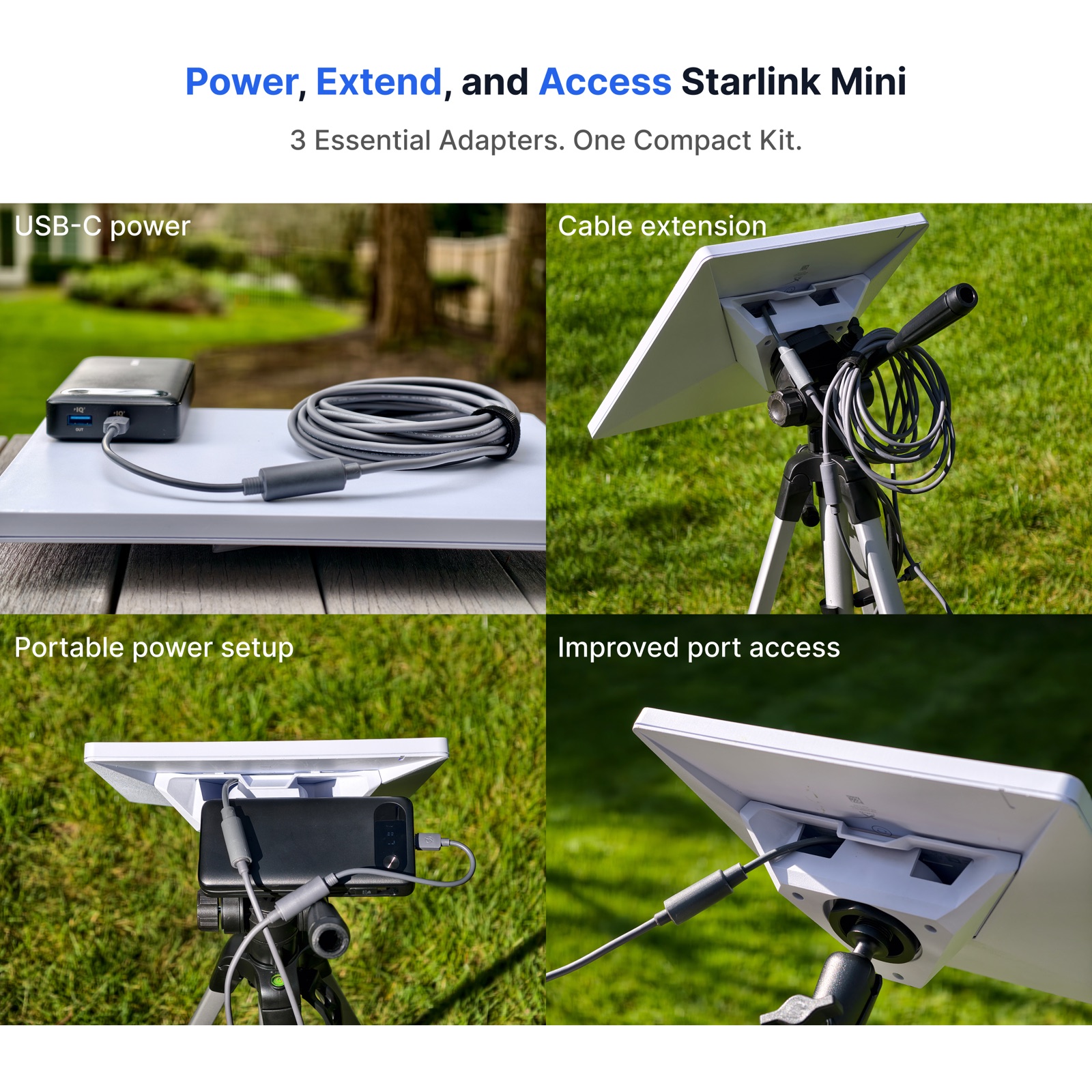
The field insight
A USB-C adapter can negotiate the right voltage and still leave a second question unanswered: what happens if voltage appears from the DC side? Reverse-feed protection blocks that unintended path. It is not the same as reverse-polarity protection.
First draw one line
Power source → conversion → cable → Mini
The Adapter Kit fixes one handoff inside that line. It does not create power, replace a cable run, or make two visually similar connectors electrically compatible.
Starlink lists Mini at 12–48V input, a 60W input rating, and 25–40W average consumption. Its official USB-C accessory path calls for a 100W USB PD source with 20V/5A capability. ↗ A large “100W” label does not prove that the source offers that exact profile.
The USB-C check most people miss
USB-C PD controls the source negotiation. The USB-IF explicitly treats power direction as a negotiated role rather than something fixed by the connector. ↗ Reverse-feed protection controls a separate circuit-level edge case: whether energy already present downstream can travel backward toward the USB-C side. Reverse-polarity protection, by contrast, deals with positive and negative conductors being reversed.
Do not treat those phrases as interchangeable, and never energize the same chain from both ends. For any USB-C-to-DC adapter, verify the exact product revision and protection evidence before relying on a reverse-feed claim.
Negotiation is permission—not isolation
A successful 20V USB-C PD contract answers, “What may this source deliver?” It does not, by itself, answer, “Can voltage applied at the adapter's DC side reach the USB-C side?” That second question depends on the converter topology and reverse-blocking components inside the exact adapter.
This matters when people improvise: a battery-backed DC rail, another live supply, or a cable already connected to powered equipment can put energy on the downstream side. The safe mental model is one active source, one intended direction, and no assumption that a PD controller is also a reverse-current blocker.
A useful buying question
Do not ask only, “Does it support 100W?” Ask, “What prevents reverse current, on which production revision, and how was it tested?” A protection icon is not the same as a circuit diagram or measured reverse-current result.
Three parts, three precise jobs
| Problem | Part | What it does not solve |
|---|---|---|
| USB-C PD source; DC5521 cable | USB-C-to-DC5521 adapter | Wrong PD profile or unsuitable cable |
| Two compatible male DC ends | Female-to-female coupler | Polarity, load, or cable-quality mismatch |
| Mount blocks finger access | Female-to-male port adapter | More cable length |
The port adapter is easy to misunderstand: it solves geometry. It brings a recessed connection outward so the plug can seat straight and the cable can leave without a hard bend.
Why a tiny loose contact can become the hot spot
Every junction adds contact resistance. The heat at that contact follows P = I²R: current is squared. A seemingly small 0.1 Ω contact at 3A dissipates 0.9W in a very small area. That is enough to make a connector—not the cable beside it—the warmest point in the path.
This is why a barrel plug that “mostly fits” is not good enough. Inner diameter, spring pressure, insertion depth, polarity, and strain all matter. Support couplers instead of letting them carry cable weight; keep junctions dry and visible; and stop if a plug feels loose or becomes unusually hot.
If the chain needs several improvised handoffs, the real answer is usually a complete cable path—not another adapter.
Read the symptom backward
| What you see | What it suggests | First check |
|---|---|---|
| Nothing starts | No valid source contract, wrong polarity, or open connection | Source profile, polarity, and each handoff in order |
| Starts, then restarts under load | Voltage margin disappears as current rises | Long cable, small conductors, or a resistive contact |
| One connector heats first | Localized contact resistance | Full insertion, fit, strain, contamination, or damage |
| Plug cannot seat behind a mount | Mechanical clearance problem | Use the port-access adapter; do not force the cable |
A 60-second setup check
- Source: confirm the actual voltage or USB-C PD profile.
- Direction: use one source; do not energize the chain from both ends.
- Fit: verify DC5521 dimensions, gender, polarity, and full insertion.
- Route: choose the shortest practical cable and support every junction.
- Run: test for restarts, looseness, or unusual heat before relying on it.
What this evidence does—and does not—prove
The voltage and USB-C requirements above come from Starlink and USB-IF primary sources. The reverse-feed discussion is a design and verification lesson; it is not a blanket claim that every USB-C-to-DC adapter includes reverse blocking. That claim must follow the exact circuit and production revision.
Choose by the missing link
Use an adapter for one connector handoff, a complete cable for a full run, and a vehicle converter when the path begins at a vehicle outlet. The WEYLCORE kit groups the three handoff tools discussed here; its product page shows the exact included parts.
Continue planning
Starting from a vehicle outlet? Read the vehicle power guide. Still choosing placement and cable length? Read Starlink Mini Power Cables Explained.
Compatibility note: Confirm the source profile, connector fit, included parts, and current product instructions before use. Keep USB-C and adapter junctions dry and free of strain. WEYLCORE is an independent accessory brand and is not affiliated with, endorsed by, or sponsored by Starlink or SpaceX.